He Left a Private Equity HVAC Company, Then Bought a Retiring Owner’s Shop
If you own an independent HVAC company, more of your callers now open with the same question. Are you family-owned, or part of something bigger? Private equity is buying HVAC companies all over the country, and homeowners notice when every visit ends in an estimate.
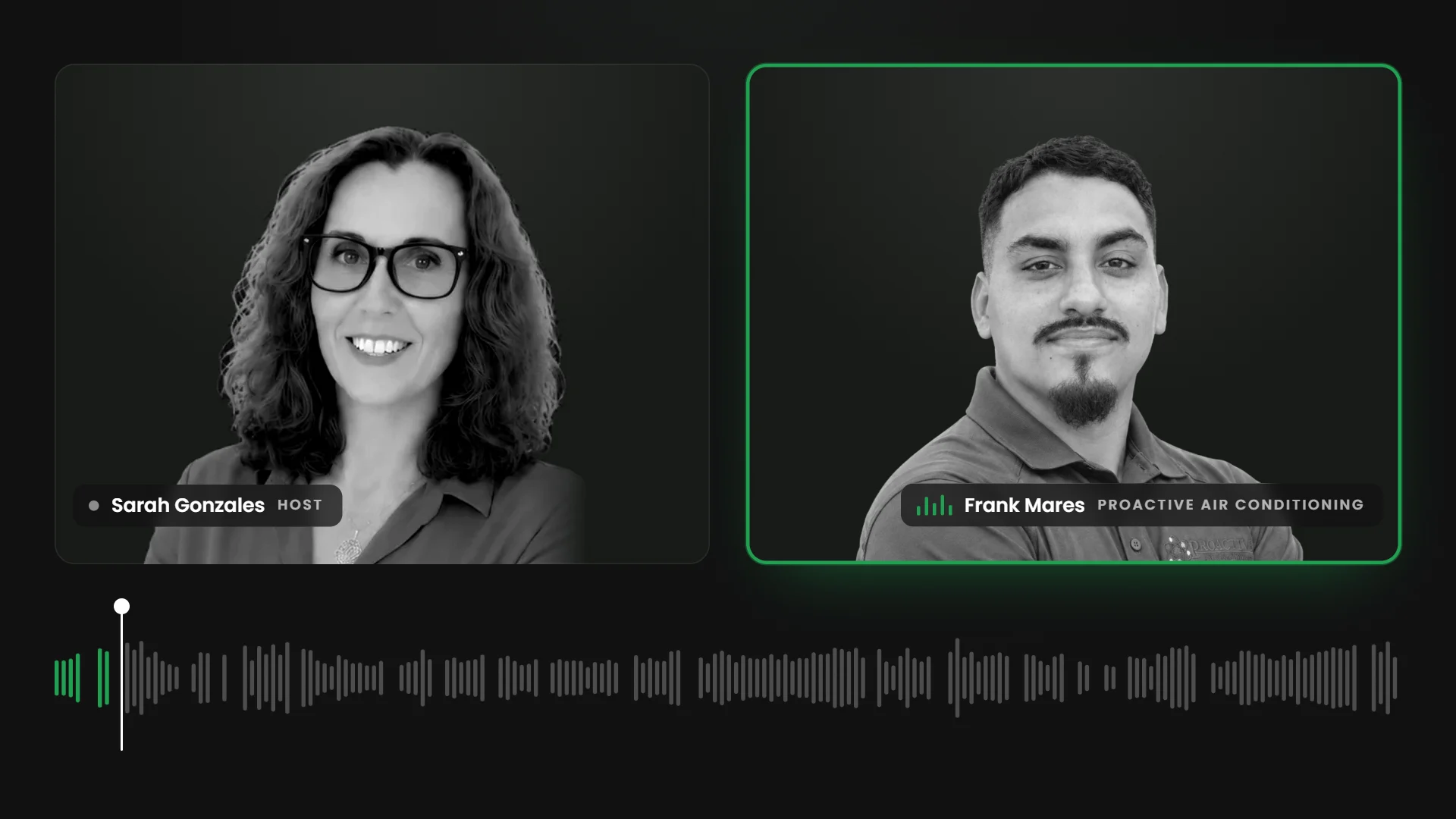
Frank Mares saw that as an opening. On this episode of Out of the Truck, Sarah Gonzales sits down with the owner of Proactive Air Conditioning, a Dallas technician with 15+ years of experience. He started his own company after the one he worked for took private equity money. In this episode, we talk about selling without pushing, giving technicians a stake in the business, and buying out a local owner who was ready to retire.

 Proactive Air Conditioning
About the guest. Francisco “Frank” Mares founded Proactive Air Conditioning, the Dallas HVAC company he has run since October 2022. Born and raised in Dallas, he worked his way from maintenance technician to lead technician at another Dallas company before starting his own HVAC company. He runs the business by the numbers and reinvests what it earns.
What You’ll Learn in This Episode
- 01What changed when investors bought in. Owners in the office gave way to an estimate on every call.
- 02How to talk to a homeowner who asked AI first. Connect what they read to how their own attic or closet install works.
- 03Repair or replace, decided by the homeowner’s plans. Two years in the house calls for a repair, seven or more for a new system.
- 04How phantom equity works in a two-technician shop. Salary, a year-end profit bonus, and a share of any future sale.
- 05Why he planned for the worst case before he quit, and how he got through a slow first winter.
- 06How he found his first acquisition on BizBuySell, and why the owner’s letter to customers mattered.
- 07Why owner-run shops rarely earn big EBITDA multiples, and the tax question that sank a deal he nearly closed.
What Changes When Private Equity Buys an HVAC Company?
When private equity buys an HVAC company, Frank says the pressure to sell reaches every call. He joined his old company when it had about seven technicians and the owners still worked in the office. Once investors came in, technicians had to write an estimate on every visit, even on a two-year-old unit.
Then came training on how to keep selling after a customer says no. Frank had been on the other end of that pitch at 17, at a fair, and bought something he didn’t want. “I don’t like that being done to me,” he tells Sarah. “So I don’t like to do it to other people.”
His own approach starts with one question: how long will you stay in the home? For a couple of years, he’ll repair the system. For seven years or more, he recommends a new one and fixes undersized ductwork while he’s there.
Homeowners have noticed the difference. More of them now ask whether a company is family-owned, and plenty ask AI about their system before they call. Frank connects that research to the house in front of him, because what works on paper changes in an attic or a closet.
Can a Small HVAC Company Offer Technicians Phantom Equity?
Yes, a small HVAC company can offer phantom equity, and Frank does it at Proactive Air Conditioning with two full-time technicians. Phantom equity is a written promise of a share of the sale price if the company is ever sold, without handing over actual shares. Frank writes it into the contract for the people he wants to keep.
| What his technicians get | How it works |
|---|---|
| Salary | The same pay in a slow winter as in a busy summer |
| Year-end bonus | A percentage of the profit |
| Phantom equity | Vests after five years, and builds by at least 1% a year when the technician meets their numbers, up to the amount agreed |
| The numbers | Work ethic, showing up on time, and callback volume |
The salary takes the worry out of winter. The equity gives his technicians a reason to care for the customers, the trucks, and the company as if they owned it. Frank saw too much turnover at larger companies, and he wants every hire to stay.
Carrying salaries takes cash, so Frank planned for it before he quit. He calls himself frugal, saved hard, and ran his start-up numbers as worst-case scenarios. His first winter was slow anyway, and his advice is to stay calm and avoid irrational decisions.
Some of the equity idea came from other businesses he heard about on drive-time podcasts. PBD Podcast, Owned and Operated, and Michael E. Gerber’s The E-Myth are the ones he names.
Frank’s equity plan started with another owner’s idea. Yours could too.
See Every EpisodeHow Do You Buy an Existing HVAC Business?
Frank bought an existing HVAC business through BizBuySell, where the owner, about to retire, had listed it himself. The owner was 71 or 72 and still climbing into attics. He’d been an engineer and got into HVAC after learning what it cost to service his own rental property.
He grew by word of mouth and the Nextdoor app, mostly on repairs, and never upsold. As Frank describes him, “If all you needed was a capacitor, he would replace the capacitor.” Another buyer worked with the owner all summer and then disappeared, so in the winter the owner came back to Frank.
Frank paid in December, a large sum for him then, and struggled through the first months before the work picked up. The owner had spent two to three years telling customers he’d only sell to someone who would treat them right. He wrote them a letter introducing Frank, and customers read it alongside the reviews.
Once Proactive Air Conditioning gets in the door, Frank expects to keep the customer.
What Is a Small, Owner-Run HVAC Business Worth?
A small, owner-run HVAC business is usually worth less than its owner hopes. Sarah says sellers under $1 million often expect three, five, or eight times EBITDA, the earnings figure buyers use to price a company. Frank’s answer is that those multiples belong to companies that run without their owner.
When the owner is also the technician, the buyer has to replace his salary and his work. So the asking price has to account for that.
His second deal came close, then fell apart over how the price was split between equipment and the rest of the business. The seller’s split would have left Frank with a tax bill he wasn’t comfortable carrying into the slow months. He says he kind of regrets walking away now.
Frank isn’t finished buying. Sarah pointed him toward SBA loans, backed by the U.S. Small Business Administration, and now he’s looking at companies priced in the millions. He expects a little over $1 million in revenue this year. Next year, he hopes to hire another technician or two and at least double it.
Bought a company, or built one worth buying? Tell the story on the show.
Transcript
Hi, welcome to the Out of the Truck podcast. I’m your host, Sarah Gonzales. This is where we sit down with HVAC leaders for honest conversations to help you grow your company, lead your team with confidence, and get ahead in a fast-changing market. Really excited to welcome today Frank Mares, owner and supervisor of Proactive Air Conditioning in Dallas. Frank is an incredible entrepreneur who has built a great company in a hyper-competitive market. So we’re going to hear about that today from him. Frank, welcome, it’s great to have you.
Hey, Sarah, thank you for having me. It’s great to talk to you again. It’s been a little while.
Meet Frank Mares and Proactive Air Conditioning
yeah, I’ve been doing HVAC for about 15 years now. Finally, I’m not a business guy. I’m just a technician that decided to take the leap, take the chance and see what happens on his own. And thankfully it’s been good so far. A lot of thanks to you guys. The marketing has been great. So that’s helped a lot. Yeah, just learning
And you started this company a years ago. I remember the first thing you told me when we first talked about why you left your long standing career working for a big company is you said that it was bought by private equity and it just became numbers, numbers, numbers. That’s what you said. Can you tell me a little bit about that experience of working for long-standing company and how that transition was and how it changed what your life was like as a technician and someone who really wants to do a really good and honest job.
What changed when private equity bought his old company
Yeah, I mean, when I started at the company, wasn’t that big, maybe seven technicians, one or two install crews, the owners were still at the office and helping out. And then obviously it grew. It was a good company. I did learn a lot there. But then obviously when it started to get investors, private equity, they have to get their money back somehow. So yeah, it just turned into a bunch of pushy sales, upsells. Sometimes the
customers do need the accessories, the extra things, but it became too, they needed an estimate in every single call, even if the unit was two, three years old and it was just the maintenance, they wanted you to
try to sell something. And it just, I don’t like that being done to me. So I don’t like to do it to other people. And that’s really
So was there ever any moment where you’re like, I don’t wanna do this anymore. I wanna own my own shop and I’m just gonna, like you said, take the leap, cross my fingers and go for it.
Not a specific moment because honestly I was treated well since the owners were still there and I was there for a while since
the company was small. They treated me very good. Maybe a little bit better than the other technicians, the new people. But really there was
not a single moment I just didn’t like to push sales on people. Even if they started doing training
to where you learn how to respond to the nose and I get a bunch of marketing sales now that after I tell them no, they start to continue to ask questions
and keep you on the phone. I hate that. If I’m not interested in the product and I say no,
no thank you. Maybe next time. That’s fine. But they just started teaching you how to.
Yeah, yeah, yeah, and I mean, especially on the phone, I’m sorry, but they don’t let you go. I just have to hang up. And that’s not the type of salesman I want to be.
The pushy sale he never forgot
somebody just kept pushing and pushing and pushing, but I was like 17 years old. I was naive and I just bought whatever product it was at that time. But that stuck to me. I hated it. I don’t want to do that to people.
Yeah, yeah, no, it’s not a great way to live. It makes you feel kind of icky at the end of the day.
Exactly. No, that’s right. That’s right. This is the place where people need to feel the most safe and then coming in. Did you feel like when you think back on that experience versus how you do sales and help guide people through something, do you feel like people understand homeowners understand that they’re kind of being sold and they’re pressed into something? Sometimes people talk to me like, I don’t think people get private equity. I don’t think they get the dynamics of commissions and everything like that. But I’m not so sure. Think most homeowners, even if they can’t quite quantify it, they feel like something’s not quite right with how much they’re being pressed into a new system.
Homeowners asking “are you family owned?”
now it’s definitely changed. Now it seems like every homeowner knows about it, which is good. Some of the homeowners they call us,
first question they ask is, are you family owned? You owned by a bigger company? And, thankfully we’re not. So, yeah, when that’s your first question,
the people know. And then with the, hi, the prices are going. Yeah, they know a lot of these people themselves
are in corporate, which Do very similar training to what they’re doing now in the HVAC sales. So a lot of people are aware
Homeowners who ask AI first
a lot of people who are learning HVAC through AI and they ask me certain technical questions when they call, which is great. Sometimes it makes our job harder, sometimes it makes it easier. But as long as they’re educated, that’s all I really care about.
Do you find that sometimes people come to you with information and you’re like, maybe what Claude told you is not quite right and then you have to kind of like have to unwind what Dr. Claude told them.
Yeah, yeah, definitely. It’s happening more and more. Obviously, AI is getting bigger and bigger.
that they have all the possibilities kind of already in their head and we just have to help them connect. By educating them the right way of how things
work out in the field. Things can be great on paper, which is what AI tells them, but out in the field where there’s an attic and a closet
disconnect things for people, even if they’re confused, does. They have the information in their head already, or they have the question that they have asked AI, so we just help connect that information for them to better understand how things really work. And what’s beneficial to them
You’ve always you’ve always impressed me as someone who really leads with. Education when you’re talking to someone about their decision to have an installation. And I know you always think of this in terms of like giving them visuals and helping them understand how a new system is actually going to work for them. Can you talk to us and take us through a little bit when you get into the house with someone, how you’re explaining to them, this is why you may need or may not need a new system and how I’m going to educate you to make you the homeowner make the best decision for you.
Repair or replace: how long will you stay in the home?
Yeah, of course, one of the biggest things that I ask is how long they plan to spend in that home. That’ll depend on how much of an investment I recommend for the home. Especially right now with the change in refrigerant, with people still having a lot of 410A equipment. Sometimes when the equipment six years old is very difficult to tell them or for them to accept that they need an entire new system to switch over to in the refrigerator So in that
part I get tired as you get them Okay, if you’re be here for two years, we can still get a fortune egg oil. Let’s do that If you’re gonna be here for ten years or seven or more Let’s put a new system because you’re gonna need it sooner or later It’s gonna come with the warranties and then also depending on how much other work they need on the install If their duck where it’s undersized, then we
Maybe they leave that for the next homeowner, but my thing is the owner’s making the best decision for them depending on how long they’re going to be there.
Yeah, yeah. Yeah, that’s always what I think about is it’s like, know, sales is about helping people make the best decision for them. And if that’s not a big sale for you, that’s OK. Then the next person may be a yes, but that person leaves. Feeling good about that transaction. I just want to read one review that I think, you know, when people leave you reviews, it tells a lot more than you or I can say about Proactive and I thought this was a really good review. Honest and affordable, Frank is truly genuine in helping you with your HVAC needs and won’t scam or upsell you. I will definitely be calling him for all my HVAC needs and maintenance. A plus plus.
Yeah. When speaking to, I think people can feel and sense when somebody being genuine to them. Really, really. So that’s why some of my questions.
Yeah. Some of my questions are just again, to educate them, to find the best deal for them, whether it’s long-term short-term. It’s everything that’s for the customer. Like you said,
they don’t go with that big sell and they move. If they move in the area, hopefully they call
Yeah, absolutely. Absolutely. I believe it. Yeah. No, that’s, know, and when you’re going to be in the area for a long time, you know, you have to play the long game when, when you’re an HVAC because over time you will have clients that you have for 20 years, right?
Right, that’s one of the things too that I look at. We can just do this repair instead of replacing the unit if that’s what the customer wants. Because all I care about is they call
us again when they need air conditioning again. When they have an issue or when it’s finally time to replace,
Starting a company in Dallas in 2022
Yeah, that’s the way to do it. So take us back to 2022 when you started your company and you you said, well, I didn’t have a lot of business experience and you’re starting this HVAC company in what might be the most competitive market in the country. Dallas Fort Worth is a very competitive market with a lot of really big players who spend a lot of money. What was running through your mind? Was your family telling you, my God, you’re crazy, we’re scared? What were you thinking about this when you were embarking on this adventure?
My main thought was what I thought coming the private equity purchasing companies all over the place. I
even if you didn’t have a bunch of customers, customers will start looking elsewhere because the prices are getting a little ridiculous. The pushing the
upsells. Like I said, I don’t like it. So I saw an opportunity for that. And like we’re seeing now, the customers are calling to ask if we’re private equity. We’re not, thankfully. So that turned out good. Me and my family, financially, I’ve always been good with my money. Let’s say that. I’m pretty cheap. I don’t splurge on things. Don’t.
Frugal, and planning for the worst case
Frugal, there you go. I mean, I don’t. I just maybe I learned it from my dad. I don’t need a brand new truck. I don’t need a dress a certain way. As long as my family’s good.
my future plans are well at that point, I obviously had to save up a lot of money to be comfortable. I do like to be comfortable. I saved up a lot
of money. I did my numbers the way I knew how to do them, which probably weren’t the right way. Cause I was, I’m not a business guy. But I set everything up as the worst case scenarios. So that’s the way I was able to be comfortable to start my own company.
Yeah. I think that’s really smart. Think one of our big Achilles heels as entrepreneurs is on the one hand, we’re optimistic. On the
other hand, we’re too optimistic. Right. And it’s great to have that optimism. I think you have to have that to do this kind of crazy thing of creating a company because otherwise, like if you were doubting yourself, you’d never do it. But on the other hand, something I see in other people and I think you you don’t fall prey to this is that there’s such an unalloyed optimism that they don’t think about the rainy days to come. And they think it is just gonna be blue skies every day of my business and I don’t need to put away a lot of money. And the first time they have a month with 20 installs, they’re calling the pool guy and putting in a pool in the backyard. And it really makes it tough when they have a down month. Or when a technician quits or that Google Ads costs go up, right? So it seems like you really kind of did it the right way.
Salaried technicians and a slow winter
Yeah, I definitely, like I I like to be comfortable myself. So when I started hiring my guys, I’m going to have you guys comfortable too. I don’t want them to worry about, we have a slow winter, we’re
to get paid. No, my guys are on salary and they know it’s going to come where they work two hours
a week or 40 hours a week. Exactly like you said, I don’t take my money and go put a bull. I take my money and reinvest into the company. I’m looking at this long
whether it’s... Well, initially I thought about AI. I have kids. Who knows what tears will be around when they grow? Who knows if college would be a smart
move? So my thought was, me go something that they can do if they don’t want to go to college or
there’s not a lot of good jobs out there anymore. Like we mentioned earlier, it’s probably... The trades are probably some of the last things that AI is going to take over. So it’s definitely a long-term thing for me. So I’m definitely investing as much as possible back into the company. And just trying to have a good culture, a good atmosphere for my technician, for the family.
Yeah. And something you said that strikes me as really smart is that your technicians are on salary, right? They only work for you. They don’t have to go off and find other work. Talk to me about how that’s enabled you to build that culture. Because a lot of people in their early days, they’re just using subcontractors and that can maybe be short term gain for long term pain. But you made the opposite call.
Phantom equity and five-year vesting
Yeah, well, a big part of that was I am giving a percentage of equity to special people. It’s
dreaming big to if it ever did sell somehow some way for whatever reason, they would get a percentage for their hard work. So. My thought of that salary wise was them not worrying about their hourly on a small company when winter comes or their pay when winter comes.
And, but I still want them to care for the customers, for the vehicles, for the company itself. So that’s where the equity part
I try to put myself into every decision I make. I try to ask myself, how would I be comfortable coming into a very small company? So salary
good ideas to, to keep your people long-term because that’s the other thing that I saw too much turnover in some of those larger companies. So yeah, all long-term
everybody I’m hiring is with the planet. Hopefully they. Love it and stay long term and incentives to stay long term which is the
Yeah. Yeah. And how did you structure that? Mean, equity programs and incentive programs and commission programs, all of it can get really, really complex legally because you have to think about like, well, am I giving equity to this person? And then what happens if they leave in three years, but I’ve given them equity and now 20 years later I sell, you know, it can get really complicated. So how did you work that out? Did you hire a lawyer? Did you go talk to people that can be really complex?
Well, no, just contract. On contract, it’s phantom equity. So they get equity only if it’s health. They do get a
But the way I structure it is they don’t get vested until five years. So that’s a portion to where hopefully
they stay for five years and they get at least 1 % per year if they meet their numbers.
their numbers and their work ethic, you know, being on time, callback volume, things like that. Again,
Running the business by the numbers
Yeah. Well, you make me laugh when you say I didn’t know much about business because you are one of the most data-driven people I know. You’re always, like you said, you’re looking at callback volume and you’re looking at all these statistics. You feel like, how did you get that mentality of kind of running your business by the numbers and really building in key performance indicators from a very early standpoint? That’s... Usually not something you see in HVAC companies until they’ve been around and frankly gotten pretty big, but you cook that in kind of from the start.
Yeah, I guess I’ve always liked math. I’ve always been a math guy. I wanted to be an engineer when I was in high school. Now that I look at it, thankfully that didn’t happen and I got into HVAC. But yeah, I’ve been,
And if the numbers don’t match, it’s not gonna work. So at the end of the day, numbers never lie. And that’s really what I go by.
Yeah, I mean, that’s the only thing, only real explanation I can give you on that. Just always liked math and I always understood it. And then blending it with the business side of things, again, putting myself in that same position. How would I like things to be ran in certain companies? Because at that company where I was before, like I said, I was one of the earlier technicians there. And I would give my ideas or what I thought to the owner, sometimes they would take them, sometimes they wouldn’t, which is fine. Same thing. I told my dad,
Hey, do you think something can work better this way? Let me know if you need me to do something better. Let me know. But yeah,
I obviously watch a lot of, business podcasts, like try to learn, go to trainings. The more I learned, more I love it. So it’s, putting the numbers
Finding time to learn: drive-time podcasts and books
Yeah, no, you were truly a continuous learner. Mean, always reading business books, always reading business podcasts, learning about AI. How do you feel like, how do you find the time for that? Obviously you’re running a busy business and I think one of the challenges that a lot of age-backed contractors find that you’ve kind of been able to overcome is carving out that time, not just to be in the moment, but also to be working. On the business and really working on yourself as a business owner and a manager and a mentor and a leader. And you’ve seemed to find the time for that.
Well, those are the things that people that don’t own the business don’t understand. It’s a lot of time. It’s a lot of dedication. I’m stuck in this room for four more hours after I get home at least, you know, going over things or learning or watching
mean, I wake up, I come to the office here, do whatever the morning things are, emails and voices. When I do have to go run calls or self calls or whatnot, I do drive a lot. So I don’t really listen to music anymore.
It’s podcasting books that I’m listening to. So that’s where a lot of the time comes from is drive time. And yet even if I’m cleaning.
Yeah, if I’m cleaning my shop or doing something, have my headphones on listening to the podcast, which is, I hate only doing one thing at a time. I feel like I’m wasting my energy doing one thing at a time.
if I’m not juggling two things, I might leave listening to try to learn other things. I don’t know. Kind of got,
So what’s your what’s your go to I’ll tell you what mine is after but what’s your go to business podcast right now? What do you love?
Yeah, anything what you’re listening to on those drives. And I’ll tell you what I listen to online.
Business in general. I got a lot out of PBD podcast I know he does a lot of political and new stuff
to but the business side of his stuff some of the business books that he recommends Big one was
for me So PBD and then another one that’s called So PBD was like general business stuff, but then I also listened to owned and operated. John Wilson in Ohio, a lot of good information. He basically gives free advice of how to run companies and
Yeah, it’s great. The other one I like that one, I like owned and operated a lot. The other one I really like is, well, I like there’s two. I’ve listened to Masters of Scale for years. If you haven’t listened to that one, I highly recommend it’s Reid Hoffman. He was the founder of LinkedIn and he is just...
I think they call him, they call him like the Yoda of Silicon Valley. He’s just an incredible educator, really insightful. And he gets unbelievable guests, Gwyneth Paltrow, [Will.i.am](http://Will.i.am), like Tim Cook, he gets everyone, right? And he’s really funny. So I highly recommend that one. The other one I’ve been obsessing over lately is, and this is a funny one, it’s called Good Bad Billionaire. It’s by these two BBC journalists and they... They will do a whole podcast on a billionaire whether that’s Taylor Swift or some Russian like mining magnet with Connections to Putin that you’ve never heard of right and and then it and they tell the whole trajectory of how that person made their billions and then at the end they do a little like 1 through 10 ranking where they rank the person on like wealth bling, evilness, and all these other funny factors. So they’re really good. And they even did it. They even did a whole season that was like historical billionaires. So they did John D. Rockefeller and you had to be dead. You had to be a billionaire and dead to qualify for that season.
but it gets a little bit of history and politics in it too. And so I like that on my drive when I kind of like have to be focusing on the road too.
Yeah, that’s the thing that I’ve learned too. Even like you said, they have a bunch of different entrepreneurs. Learned that
some ideas, some information that you get, even if it doesn’t pertain to your business, you can apply them somehow, some way. If it’s a great idea, it’s a great idea. You just
some of the equity stuff that you asked me about earlier from just other businesses doing it.
Yeah, I agree. Think I think creativity really comes from making connections across disciplines and across sectors, right? Another one that I’ve listened to for years and is really good is, do you know this one, the Daily Stoic? It’s this guy, he’s a business guy, but
he sends out a daily email and he has a short podcast. And it’s all about stoic philosophy and Marcus Aurelius. And that sounds so crazy, but it is really, really good because he talks about like Roman philosophy and this kind of idea of stoicism in the context of business and emotional self-regulation and how to be a leader that really listens to other people and he draws on the lessons of Emperor Marcus Aurelius who was very well known to be a wise person. So sometimes these really interesting connections are where I get the most creative ideas for my business. So I enjoy those as well.
Staying calm through a slow first winter
Yeah, and that’s something that’s a very important thing in business because let’s say your winter goes horrible.
You got to stay calm and figure it out and find other things to do, other ways to make money, other ways to grow the company. Yeah.
If you have people sitting, I said, I’m still paying them. So it’s coming out of the company, the town is going down. I’m getting a little worried, but that helps a lot. It’s goes to them, especially in business,
Yep. And I have to remind myself sometimes I’m like, my team is looking at me to set the pace for how much they should freak out about something. Right. And so if I’m sitting there, my gosh, what are we going to do about the bank account or what are we going to do about this client? And I’m worried, then that’s going to make them worried. But if I’m like, okay. There are rainy days, we’re gonna solve this together and their highs and their lows, we celebrate the highs and the lows we work on together. It helps them keep that same pace and not worry and stew on this in their stomach. And it requires a lot of discipline because then that’s what I love my husband for because then I can go and freak out with him and be like, I’m really worried about this. And then come
Yeah, I guess there was a time where maybe at least for my comfort level that I like to be at the winter time, like probably my first winter, really slow, saw the count going down, down, Started worrying a little bit, but
Yeah, it’s that combination of optimism. Yeah, no. So one other thing I want to ask you about is you’ve grown the company in an interesting way. You’ve had very early on a small acquisition, and then you’ve looked at some others. Can you talk about your approach to acquisitions? Because I think a lot of people think acquisitions are just for very big companies. And when you’re doing an acquisition, it has to be this kind of multimillion dollar deal.
Buying a retiring owner’s company
Yeah, I think I got very lucky or very blessed to find the acquisition that I did find just because it was a older man that was ready to retire that really only did repairs.
he did installs too with sub-proof, but his thing was never upselling, never extra. If all you needed was capacitor, he would replace the capacitor. Customers happy, as long as the unit keeps running.
So it was one of those that everybody trusted him, because he was an older, very nice guy, very good guy, everybody loves him. Customers that I go to now ask me
about him. Everybody loves him. He’s just one of those old school, hardworking, his wife made him sell the company,
because he was still trying to be, he was 71, 72 years old, in addicts, I couldn’t believe it. I didn’t want to do that. But he’s one of those old school hardworking men, a great guy. Yeah, he’s just
getting a little older and he was finding somebody good to sell it to because he could have sold it to a bigger company very easily. A lot of his customers,
And after engineering, did HVAC because he had a rental property that needed HVAC and he found out how expensive they were. So he started doing that. That started
on his side. And it just grew. The only thing that he did was word of mouth and Nextdoor app. So like I mentioned, he lives in a great area and
only neighbors basically called him and he started growing that way. So that’s another reason why I think I got very lucky and took the chance. Because everybody trusted him, no upsells. It was affordable for me at the time. And I just took it and I believe the portion that I just mentioned where it was a little bit more recent was right after I purchased it
amount of money for me. And I got less worth, very little and just struggled through the beginning of that year. Then things picked up and it went great. I think I got blessed with that opportunity. Haven’t been able to find one like that again. Been looking at others that aren’t very interesting.
The letter to his customers
And he recommended to you, I think what I recall is that before he retired, he also sent an email to all of his customers to say, hey, I’m selling to Frank Mares of Proactive. I vouch for him. I could have sold to bigger people, but I trust him. And I know he’s going to carry on the values of honesty that you’ve enjoyed with me for many years. Did that help
Well, I kinda did that, Yeah, I had him write a letter recommendation for me or just telling his customers. He had been mentioning to his customers
for about two years that he was trying to sell the company. So a lot of his customers already knew like two, three years before
that he was telling them, hey, I want to sell, want to sell myself. But he was obviously trying to find somebody good that would take care of the customers just like he did. So that’s why it took a while. But most of them knew. Yes, they he wrote a letter to explain, you know, he’s retiring
and He finally found somebody that he was comfortable with taking care of his customers. And yeah, of course, that helped the confidence of the customers that and then the reviews like you saw some of the customers go and read the reviews, read his letter. So
they’re they’re comfortable. Then once we do get in the door, that’s my only thing. As long as we get in the door, I think we’ll get every single client just because we’re honest and genuine.
Right. Mm-hmm. Yep. Yeah. Yeah. Yeah. And you’ve had some other acquisitions that you’ve looked at, nothing yet, but I know there was one that you kind of were looking at pretty seriously and then at the end it fell through. You don’t need to talk about the name of the company because I know they’re still active, but tell us about that process.
The deal that fell through
That process was actually great. Again, I don’t know if I got to let you hear what’s going on, but I got to deal directly with the owner. I got in touch with the broker, but
then I guess the owner wanted to talk about certain things the way he wanted to do it. So we just got in touch and we dealt with
the entire thing. We almost closed. Only reason we didn’t was because he was trying to, he wanted more value on the FF&E. Or
less value on that and more on the, forget what the other portion is called. So I would end up paying a lot more taxes than I was comfortable with the following year. That was really the thing, because I was gonna give
up a lot of money and then again, I’ve been kind of worried about the slow season and being able to pay the large amount of taxes because they weren’t gonna be obviously deductible
from that purchase. So that was really the thing that made it fall through. Now I kind of regret it, but hey, living you learn.
Finding listings on BizBuySell
No, there’s a few websites online that sell businesses and that’s all I look at into. There’s two,
think, BizBuySell and I forgot the name of the other one, but BizBuySell is actually where
I found the one I did purchase. He listed it on his own. Him and his wife were dealing with it. And, and, actually again,
that’s why I think I got blessed with this one because somebody else was due to purchase that one, but it fell through. He worked with him throughout
They had this myself where I found that one. And that’s where I looked. That’s where I, I’ve seen a few here lately, but not very interesting for what
Why owner-run shops don’t get big multiples
Yeah, that’s sometimes the challenge is you have to kind of bring the owner down to earth because especially if it’s an acquisition under a million dollars, sometimes in their head, they’re thinking, well, know, HVAC companies sell for three, five, eight times EBITDA. That’s what I need to get to. It’s like, right. But if your earnings last year were 200,000, then you’re not going to necessarily get that kind of multiple.
And those EBITDA multiples are only there when it’s set up as an actual business where somebody that doesn’t even know about it can buy it and run it. They have everything set up to where can run itself.
These are not that way. These are owners that I would have to replace. I would have to replace their salaries. I would have to replace their work. So they’re not willing to deduct that from the price.
Yeah. Yeah. Yeah. No, it’s true is as much as everyone always says that the &A market for HVAC is so hot. There is kind of sometimes this disconnect between sometimes owners who don’t know what their business should have looked like and how they should have spent the previous five years preparing to make themselves completely outside the business. So the business runs without you whether you come in today or not. And they haven’t done that.
they’re worth it, but, you know, they can be bought and ran on their own, which is the big difference that some of these don’t
Yeah, yeah. So it’s really about finding that opportunistic buyer who has a good business that you could kind of roll into yours, but also has an understanding that maybe they’re not going to get that kind of multiple. But they still maybe are in another market that’s complimentary or even if it’s just 10 miles away.
Yeah, yeah, exactly. I’m very interested because I can just take it over and have license. I have everything that is needed. But I do have to replace the workers. I have to replace those salaries. And so that tries me to come down a little bit.
Yeah. Yeah. Yeah. Well, maybe not all of them because you have the apparatus of sales and, and CSRs and everything like that. So at least there would be some that you wouldn’t have to replace.
Yeah, I the main thing is the the owners being the people that work that I would have to replace that That’s the thing that I’m having a hard time them understanding The price has if you’re gonna have to do that, then the price has to
Where Proactive is now and what’s next
Yeah, yeah, yeah. So when you look ahead, let’s say 12 months and five years, like where are you now in terms of revenue, trucks, technicians, where do you want to be in a year and where do you want to be in five years and what do you think you need to do to get there?
and then in five years, I don’t know. I don’t want to grow too fast. You know, I want to,
like, this is where I struggle on the things that I do learn about business that Hey, you have to let go some things. You have to hire
things done a certain way. So that’s why I struggle letting things go. But that’s where I also am investing into my guys because I want them to be the ones to take over my the things I oversee so I can trust them.
They know how I work. They know what I expect. So maybe that’s why I want to grow a little bit smaller or slower than what I possibly could
I haven’t thought about that. I really haven’t. I will, you know, I do my business planning here in December, which obviously five years does have to be a target. But
I’ve really just as of right now, I thought about next year, hopefully hiring a tech. A tech or two more, hopefully doubling the revenue
But yeah, am December. We’ll have another podcast after December and I can give you all those answers.
That sounds good. Yeah, yeah, yeah. We’ll help you brainstorm what your 2027 numbers are going to be. We’ve done our own goal
setting. We did our one, three, and five-year and 10-year goal setting, and it’s really good. I find having the team really focus on these big 10-year goals is ambitious and it’s intimidating, but it also gives you a little bit of a roadmap of where you can be and gives you that focus. So I highly recommend.
Yeah, this is actually my first, I hired my two guys. I do have a heart of this year. So I also want to bring them
in into all those ideas and all the goals that we have for the next couple of years, five, 10 years.
can’t wait to hear about it. So tell us what it’s been like to work with a digital marketing agency, to work with us, RS Gonzales, and how that experience has been for you in terms of your own growth and partnership.
Great. It’s been great working with you guys. Really no complaints. Like I mentioned earlier, Todd reached out to me. I reached out to him about training. He reached out to me once he saw the website, asked about you guys. He was impressed on the website, your
guys’ website. And I kind of sold him, sold you guys to him because it had been great. Thankfully,
that you guys have done have been great. So I told him I did run ads for a few weeks and it was just a little too much for our capacity right now. So obviously that was a great job you guys did. And yeah, it’s been great. One of the, I don’t know if I ever told you this, but one of the reasons I decided to go with you guys is because you spent, I would say probably a total. Of three and a half to four hours explaining things to me before I even signed anything or gone on with you guys. So you go off education just as much as I do. You educated me, so I felt comfortable going
with you and knowing that you guys know what you’re doing on the back end to get me where I’m supposed to be. So same route I take with educating our customers. Education is key for people to be comfortable and know that they made the right
Yeah, I know. I tell people, I’m like, listen, I work with HVAC contractors all day long. I know that Saturday morning is sometimes the only time you have time to talk. So here I am sitting in my office having those conversations. It’s the time people can be really leisurely about it.
Yeah, I tried maybe two other companies before I got on with you guys. 9 day 9 day in the communication and the education and in the results so A plus for me as of right now
Thank you. Really, really appreciate that. Well, Frank, it has been great talking with you today. We always admire the business that you’re building and to have the success that you’ve had and be able to really double your business in the last year or more in such a competitive market while just getting nothing but five star reviews and raves about your integrity and already thinking about how to become like an acquisition entrepreneur. Even this early in your journey is something I think a lot of people can learn from is really inspirational for all of us. So thanks for joining us today. Thanks for sharing your wisdom. It’s been a real pleasure.
SBA loans and bigger acquisitions
Yeah, of course, sir. Thank you for talking to me. One more thing that you also pointed me towards with SBA, speaking of acquisitions, I’ve been looking at even the ones that
and the direction you pointed me towards for SBA and just running the numbers. I it would make sense. And we run things properly. We’re going to be successful. So that’s where I’ve gotten the confidence and you helped me a lot.
That is. Thank you. And that’s a great note to on. I can’t wait to when you call me and let me know about your first multi-million dollar acquisition.
Yeah, thank you. And thank you everyone for joining us today. It’s been such fun talking to Frank Mares of Proactive and wishing everyone a great day.